

Simple Art Pricing Formula
A straightforward way to price your art is:
(Hourly Rate × Hours Worked) + Materials × 3 = Base Price
Then many artists multiply that final number again to include skill, demand, and profit margin.
This gives you a clear price that covers:
- Your time
- Your materials
- Your value as a creator
- Your business sustainability
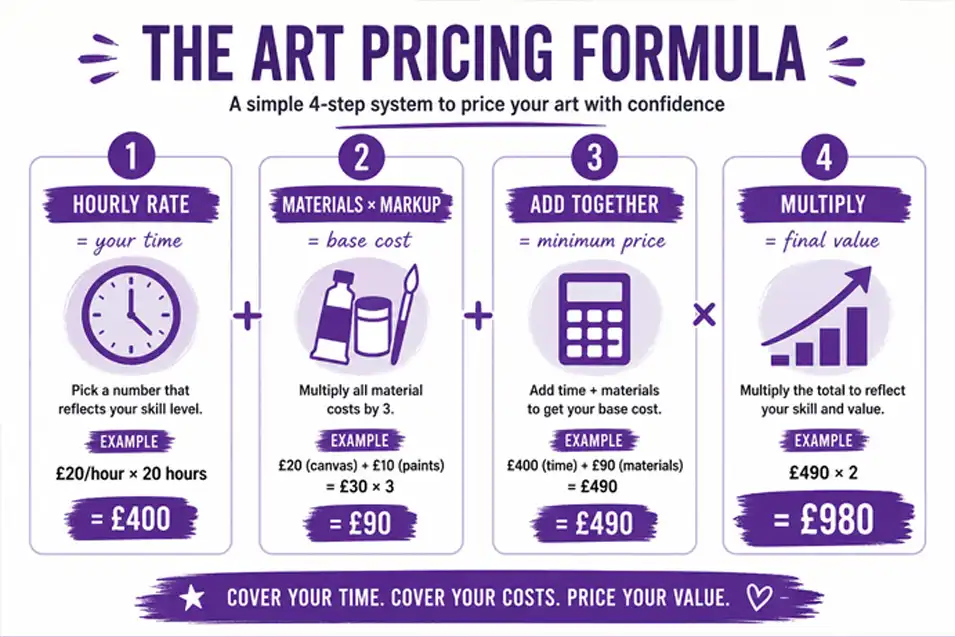
Pricing your art is about combining time, materials, and perceived market value into a consistent system that allows you to price work with clarity instead of guesswork. Everything else in this guide builds on that foundation.
How to Price Your Art?
Here is a system I used for years…
- Set an hourly rate. Pick a number that reflects your skill level (this is wholly subjective). For example: £20/hour × 20 hours = £400.
- Mark up your materials. I used to multiply all material costs by 3. For example: Canvas and paints (bare minimum). £20 + £10 = £30 × 3 = £90. This covers waste, restocking, and gives you a margin.
- Combine time + materials. Add those together to get your base cost. £400 + £90 = £490. This should be your bottom price if you truly value your time and money you used to buy the materials.
- Multiply the total. I used to double it. Why? Because your skill has value. Not everyone can do what you do, and your pricing should reflect that. So, £490 × 2 = £980
The Minimum You Should Charge for Artwork
If you’re feeling overwhelmed by all of this, strip it right back to this:
Your price should, at the very least, cover your time and your materials. Everything else builds from there. If you’re not covering those two things, you’re not really pricing your work – you’re subsidising it. Once that foundation is in place, everything else becomes about positioning, confidence, and audience rather than guesswork.
Common Mistakes I See Artists Make
There are a few patterns that show up again and again when people struggle with pricing:
• Pricing based only on materials and ignoring time entirely.
• Copying someone else’s prices without understanding their audience or location.
• Undervaluing work just to "make it easier to sell".
• Not adjusting prices over time as skill improves.
• And probably the biggest one, hoping the buyer will decide what it’s worth.
If you don’t decide, someone else will, and they’ll usually decide low.

How Beginner and Professional Artists Price Their Work Differently
Not everyone is working at the same pace or skill level, so it helps to see how this shifts in practice.
For example: A newer artist working at a slower pace might set a lower hourly rate, maybe £15/hour, simply because they’re still building speed and consistency.
An artist with more experience might sit closer to £30–£40/hour because their output is faster, more refined, and more in demand.
Someone doing highly detailed or large-scale work might naturally have fewer hours available per piece, but the value per hour goes up because of skill density.
The key thing here is not copying numbers. It’s understanding the structure behind them and adjusting it to your reality.
The formula doesn’t care who you are, but your confidence and consistency should shape how you apply it.
Why Artists Undercharge Their Work
Let me start with a simple question,
Would you get out of bed and go to a job for less than minimum wage?
In the UK right now, that’s around £12 an hour. If you’re pricing your work in a way that pays you £5 an hour… what are you really doing?
Maybe you’d genuinely be better off getting a regular job? Obviously none of us want to do that and sacrifice doing what we love! But it’s important to think about.
The second thing to take into consideration.
Every business on the planet marks up its products or services, so why shouldn’t you?
(Not that every artist is trying to run an actual business).
And thirdly,
Can everyone else do what you do?
If the answer is no, and it most likely is, then your work has value beyond just time and materials.
At the very least, your pricing should cover:
• Your time
• Your materials
That’s a good foundation.
Materials add up quickly. Paints, canvases, brushes, easels… then things people forget, rent, exhibition fees, stall costs, gallery commission, even electricity (unless you paint in the dark!). It’s not that cheap to be an artist.
Hidden Costs Many Artists Forget
A lot of artists only calculate paint and canvas costs, but there are usually other expenses involved too:
- Exhibition fees
- Gallery commission
- Website costs
- Packaging and shipping
- Market stall fees
- Studio rent
- Marketing
- Printing
- Software subscriptions
These overheads matter because sustainable pricing is about more than just materials alone.
Real Example of Pricing Artwork Successfully
As a young artist back in 2007, in my small town, I used to try selling 30x40cm acrylics on canvas for £50. I just plucked the number out of the sky. Nothing. I dropped them to £30. Still nothing…
A while later I did my first ever Art Market in Liverpool (UK). I painted 35 canvases, I was super excited! The day before the market I had a conversation with an experienced Community Artist – she asked me how I was pricing my work.
"Eh? What do you mean?" Was my response… I listened to her advice and implemented what’s outlined above. The following day in Liverpool I sold 18 of the canvases for £150 each! OMG I couldn’t believe it!
That was a turning point. It made something clear to me. Pricing not just about the work. It’s about where you’re selling, who you’re selling to, how it’s perceived and subject matter in relation to location.
Location matters. Audience matters. Presentation matters. And YOU matter, your time and skill matters!
You can have the right price in the wrong place and it just won’t sell, even if you lower the price. Once your pricing feels solid, the next step is understanding where your work actually sells best in real markets. My Where to Sell Your Art guide might help you at this point.
Pricing should be about;
• Respecting your time
• Understanding your costs
• Recognising your value
Get those right, and pricing becomes a lot less hard work and a lot more sustainable.
I fully appreciate there is always going to be people who’s art commands 100 +hours. I hear this a lot: ‘Even if I charge minimum wage per hour (£12) plus materials and then double the price – it would be like £3000! Who’s going to pay that!?’
When artwork doesn’t sell, the issue is usually not the pricing formula itself, but audience fit, market positioning, and where the work is being shown. Remember your Art is not for everyone, some people will say ‘What! How much! I could do that myself!’ Some people will outright slam your work. Some will laugh in your face and walk away….I’ve heard it all… But this is OK, these aren’t your people. It doesn’t mean you should lower your price.
Go find the people who truly value your time and skill – in return you’ll start to value yourself, and the ‘price’ will become a byproduct of what you love doing.
Other Ways Artists Price Their Work
Not every artist prices work the same way. Some artists charge:
- By hourly rate
- By canvas size
- By market demand
- By collector interest
- By gallery pricing standards
Over time, most artists end up combining several approaches depending on the type of work they create and who they’re selling to.
Frequently Asked Questions About Pricing Art
How do I price my art as a beginner?
Beginner artists usually start by calculating a basic hourly rate plus material costs. A simple starting point is:
- Estimate how long a piece takes
- Choose a fair hourly rate based on skill level
- Add material costs (canvas, paint, tools)
- Add a small buffer for overheads
As experience grows, prices should gradually increase to reflect improved skill, speed, and demand.
What is the best formula for pricing artwork?
A widely used formula is:
(Hourly Rate × Hours Worked) + Materials = Base Price
Many artists then apply a multiplier to account for:
- Experience
- Demand
- Positioning
- Profit margin
This creates a more sustainable final selling price.
Should artists charge hourly or per piece?
Both methods are used, but they serve different purposes.
Hourly pricing works well for:
- Beginners
- Commission work
- Building consistency
Per-piece pricing works better when:
- you have an established style
- demand is consistent
- your work varies in speed or complexity
Most experienced artists eventually move toward value-based pricing.
Why is original artwork so expensive?
Original artwork is expensive because it reflects more than materials. Pricing often includes:
- Tome and labour
- Years of skill development
- Originality (one-of-one work)
- Creative value
- Market demand
- Scarcity
Unlike mass-produced items, original pieces cannot be replicated exactly.
Can I increase my art prices over time?
Yes. In fact, most artists should. Price increases usually happen when:
- Skill improves
- Demand increases
- Sales become more consistent
- Exhibition history grows
- Audience expands
Small, consistent increases are normal in the art market.
How do galleries price artwork?
Most galleries apply a commission model, typically taking between 30%–50% of the final sale price. Because of this, artists usually set higher retail prices to ensure they still earn a sustainable income after commission.
What to Do Next as an Artist?
Once pricing starts to feel grounded in your time and skill, the next question becomes what buyers are actually doing with their money right now, and why some work sells faster than others even at higher prices. Looking at current spending patterns helps connect pricing decisions with real demand shifts. Read our Geek Gift Spending Trends 2026 to learn more.
Understanding how people spend is only half the picture. The real advantage comes from turning that into ideas people can actually buy, gift, or collect. That’s where a more practical breakdown of ideas becomes useful our Geek Gift Guide might shed some insights.
We hope this little guide has been of help. If you have a different way of pricing your art we would love to hear about it. Drop us a comment.